 Premiablue
 strategy vaults used provider-specific fees for automated options strategies
Premiablue strategy vaults automated options strategies under fee terms that distinguished native, in-house products from third-party vaults. The September 2023 V3 schedule listed a 2% annual management fee and a 20% fee on positive returns for native vaults. Third-party vault fees required separate negotiation. Premia Labs announced the halt in V3 development on August 15, 2025, so these figures describe legacy terms. Comparing a vault required its provider, strategy, and applicable fee bases.
Under the September 2023 V3 schedule, native vaults charged 20% on positive returns, excluding the original deposit from that fee base.
Match the provider to the legacy vault
The V3 distinction concerned who developed the vault: Premia teams built native products, while third parties could build their own strategies. That distinction determined whether the published native schedule applied. A vault's participation in the same exchange did not make its commercial terms identical to another provider's terms.
The Vault Depot supplied smart contracts that partners could use to deploy automated strategies atop Premia. A partner's deployment needed its own terms, even when it interacted with familiar pools or appeared alongside other liquidity sources.
Historical capability descriptions explained the legacy architecture; they did not establish whether a particular vault currently accepted deposits or supported an immediate exit.
Strategy execution through range orders or quotes
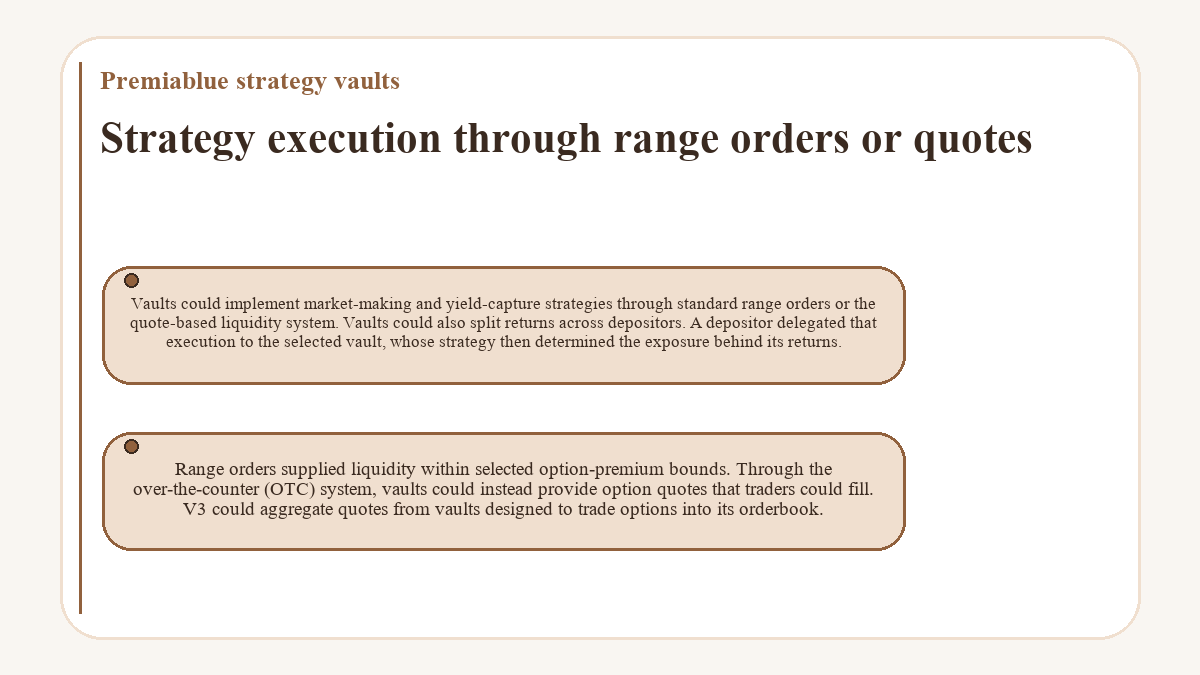
Vaults could implement market-making and yield-capture strategies through standard range orders or the quote-based liquidity system. Vaults could also split returns across depositors. A depositor delegated that execution to the selected vault, whose strategy then determined the exposure behind its returns.
Range orders supplied liquidity within selected option-premium bounds. Through the over-the-counter (OTC) system, vaults could instead provide option quotes that traders could fill. V3 could aggregate quotes from vaults designed to trade options into its orderbook.
Which vaults carried the native fee schedule?
The September 7, 2023 V3 fee schedule assigned the published management and positive-return rates to all native vaults built in-house. It left third-party vault charges to case-by-case negotiation.
The September 2023 native V3 vault schedule included a yearly management fee of 2%. An annual rate needed a defined fee base and accounting period before it could produce a monetary charge. That percentage alone did not establish a flat deduction from every deposit, regardless of holding time.
The separate 20% fee applied to positive returns. The original deposit and the positive return were different quantities, so applying that rate to the entire balance would use the wrong basis. The applicable accounting terms still mattered: a percentage did not specify how a particular vault measured returns or when it collected the charge.
V3 allowed rate changes through vxPREMIA governance vote and ratification. The applicable schedule therefore mattered alongside the developer's identity. Third-party negotiation could produce a different fee arrangement, so the native percentages supplied neither a universal upper limit nor a default rate for partner vaults.
A fee estimate that lacked a provider rate
Could the native performance-fee calculation also price a third-party vault? Consider hypothetical positive returns of 1,237 accounting units, already measured on the relevant vault's fee basis. These units express value without choosing a deposit token. Assume the September 2023 native rate applied unchanged, and isolate the performance fee from all other costs.
For the native vault, multiplying 1,237 by 20% produced a performance-fee estimate of 247.4 accounting units. Subtracting that charge left 989.6 accounting units of positive returns before other applicable costs. This calculation did not estimate a management fee, trading expenses, or a future strategy return.
Applying the same 20% to a third-party vault failed to establish its fee because the negotiated rate was missing. The comparison used the same return amount and fee category, but the provider type changed which rate applied.
Before repeating that estimate, replace the borrowed native rate with the third-party vault's actual negotiated rate. If that rate is expressed as a decimal r and uses the same positive-return basis, its fee equals 1,237 × r.
Exchange charges used different calculation bases
Trading commissions belonged to the base exchange layer, while the native management and positive-return charges belonged to the vault layer. The September 2023 base-layer schedule used the greater of 3% of premiums paid or 0.3% of notional value transacted. Premium meant the option's price; notional described the transaction's reference value.
Those amounts differed from a vault's positive return. Comparing 0.3% with 20% as though both charged the same balance would misstate their meaning. A vault cost assessment also needed the trading expenses that its strategy incurred and their treatment in its accounting. The relevant calculation combined charges in common value units after applying each fee to its own base.
Predictable fee inputs did not fix strategy returns
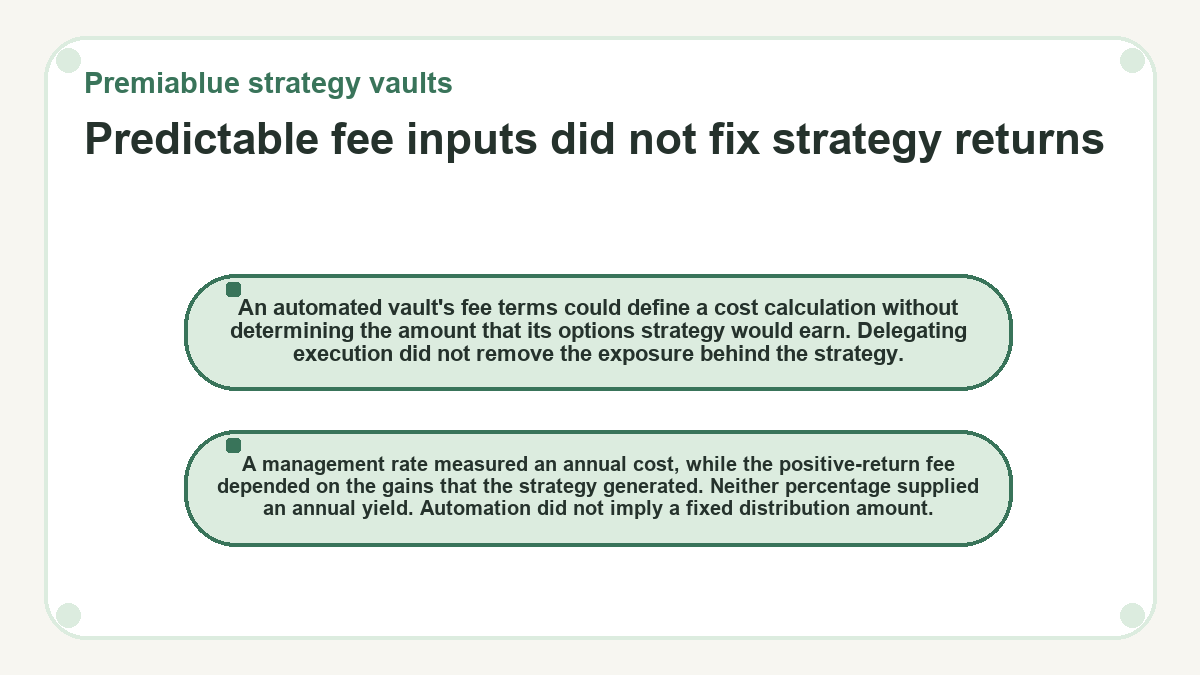
An automated vault's fee terms could define a cost calculation without determining the amount that its options strategy would earn. Delegating execution did not remove the exposure behind the strategy. A management rate measured an annual cost, while the positive-return fee depended on the gains that the strategy generated. Neither percentage supplied an annual yield. Automation did not imply a fixed distribution amount.
Keep later yield plans separate from V3 terms
Premia Labs announced plans for a passive-yield product within Kyan on August 15, 2025, alongside its explanation of halted V3 development. The proposal included shared liquidity between Kyan and Archetype. That announcement described a later product direction; it did not give existing V3 vaults a new common management or performance-fee schedule.
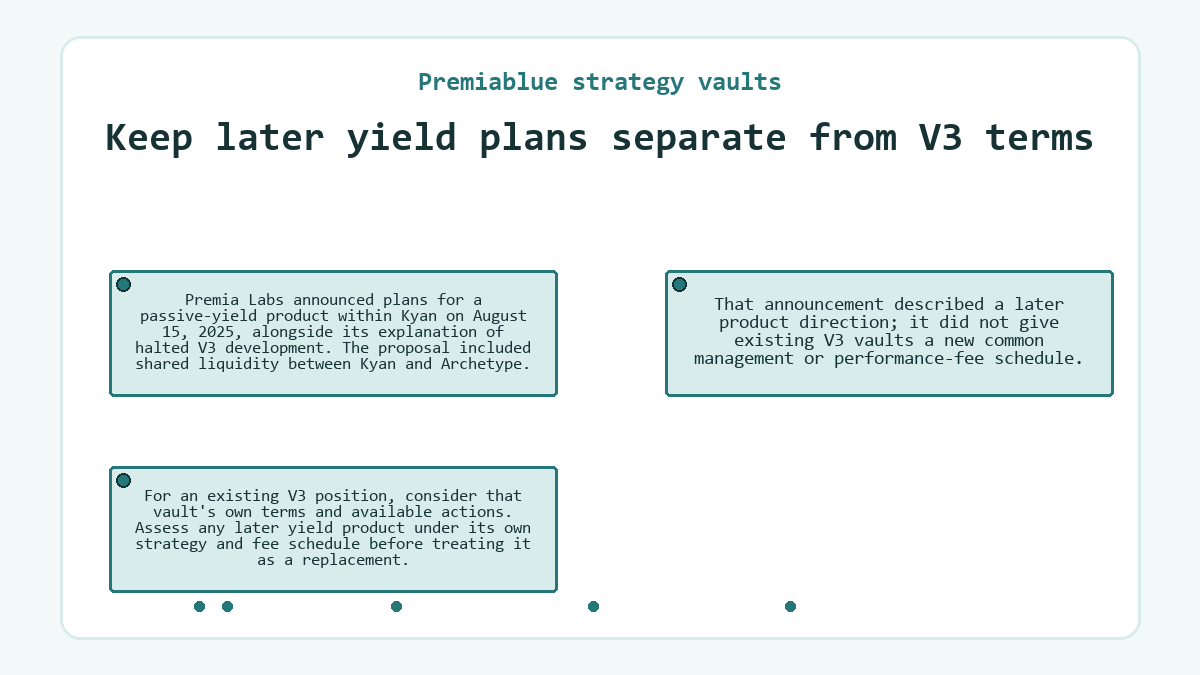
For an existing V3 position, consider that vault's own terms and available actions. Assess any later yield product under its own strategy and fee schedule before treating it as a replacement.
Popular questions about Premiablue strategy vaults
-
Did locking PREMIA reduce a native vault's management fee?
- The V3 vxPREMIA discount applied to trading fees, without establishing a reduction in native vault management fees. A management-fee reduction would need its own applicable vault term; the trading discount alone did not supply that reduction.
-
Where did the legacy vault-layer fees go?
- The September 2023 V3 model allocated 100% of vault-layer fees to the Insurance Fund. That allocation concerned collected fees, not the depositor's entire balance or every strategy profit. The separate allocation of 80% of base-layer fees to vxPREMIA holders did not describe the destination of vault-layer charges.
-
Could several V3 strategy vaults supply the same pool?
- Several vaults could supply liquidity to one pool in the V3 design. This many-to-one relationship connected separate strategies with the same market. Shared pool access did not turn those vaults into a single product or give them identical provider fees.
-
Was a V3 vault position the same as a vxPREMIA lock?
- A V3 vault position involved an automated strategy, while vxPREMIA came from locking PREMIA for staking benefits. The staking lock governed benefits such as voting and trading-fee discounts. Its published lock periods did not establish a separate vault's withdrawal terms.
-
Did the V3 development halt set a common vault exit deadline?
- The August 15, 2025 development-halt announcement did not establish a common exit deadline for every vault. A halt in development did not specify each position's withdrawal window or settlement timing. Those details remained specific to the vault and its state; the announcement did not establish unlimited withdrawal availability either.
Updated